Showing posts with label Research. Show all posts

Monday, 30 November 2015

Bibliography

Books
  • Susan Doran and Norman Jones, 2014, The Elizabethan World, Routledge Worlds
  • Chapters 4 and 5, in: Fenja Gunn, 1973, The Artificial Face: a History of Cosmetics, David & Charles, pp. 53-88
Videos

Websites


Films

  • Elizabeth, 1998, directed by Shekhar Kapur
  • Elizabeth: The Golden Age, 2007, directed by Shekhar Kapur
  • Funny Face, 1957, directed by Stanley Donan
  • Seven Photographs that changed Fashion, 2009 (TV), BBC 4, Wednesday 14th January 21:00, presented by Rankin


Galleries

  • National Portrait Gallery, visited on Thursday 15th October

Wednesday, 4 November 2015

Elizabeth Brydges and final design idea face charts


Elizabeth Brydges, 1589

  • Daughter of Giles Brydges (the third baron Chandos)
  • Liked embroidery: gowns, silks, fabrics, intricate detail > I noticed that in many portraits she wore dark dresses; black, dark blue - symbolic of nobility
  • Liked jewels
  • Enjoyed reading and music
  • Had a romantic affair with the Earl of Essex (which offended Queen Elizabeth)
  • Was turned out of the Coffer Chamber for going to watch the Earl play without permission
  • Was included in Queen Elizabeth’s funeral processions
  • Married a married man
  • Died deserted, in poverty
  • Dog in portrait; symbolises faithfulness

http://www.geni.com/people/Elizabeth-Brydges/6000000012481831915

Thoughts:                                                          
  • Disobedient/defiant/unruly – playful
  • Doesn’t follow conventions
  • The idea that dogs symbolise faithfulness seems ironic; offending the Queen with her romance with the Earl of Essex, and generally misbehaving
  • In the modern day we associate dark colours, like she often wore, with the above qualities
  • Enjoyed luxuries
  • Ultimately sad ending; perhaps karma; foreboding  

Firstly, I wanted to play around with my own ideas and thoughts that I had reached from my knowledge of Elizabeth Brydges. I initially felt inspired by the idea of dark colours representing a devious nature. I opted for a deep greyish-purple lip and reddish-orange eyes. I liked the idea of bold brows to modernise the Elizabethan look, contrasting the typical bleached or bare brows from the period. I used bronze and gold tones to contour the face. This, and the eye colour choice was because I had not applied the typical red lip, but still wanted to include the typical Elizabethan colours, or reds, oranges and golds. To mirror the usual Elizabethan pale and minimal eye make-up, I decided to use a white mascara. I liked the finished look, although felt the colours were quite muted, and would have preferred at least some of the face to be more bold, e.g. the lip colour. I found it quite challenging working on paper instead of a face, but an effective way to plan and experiment with make-up ideas.  


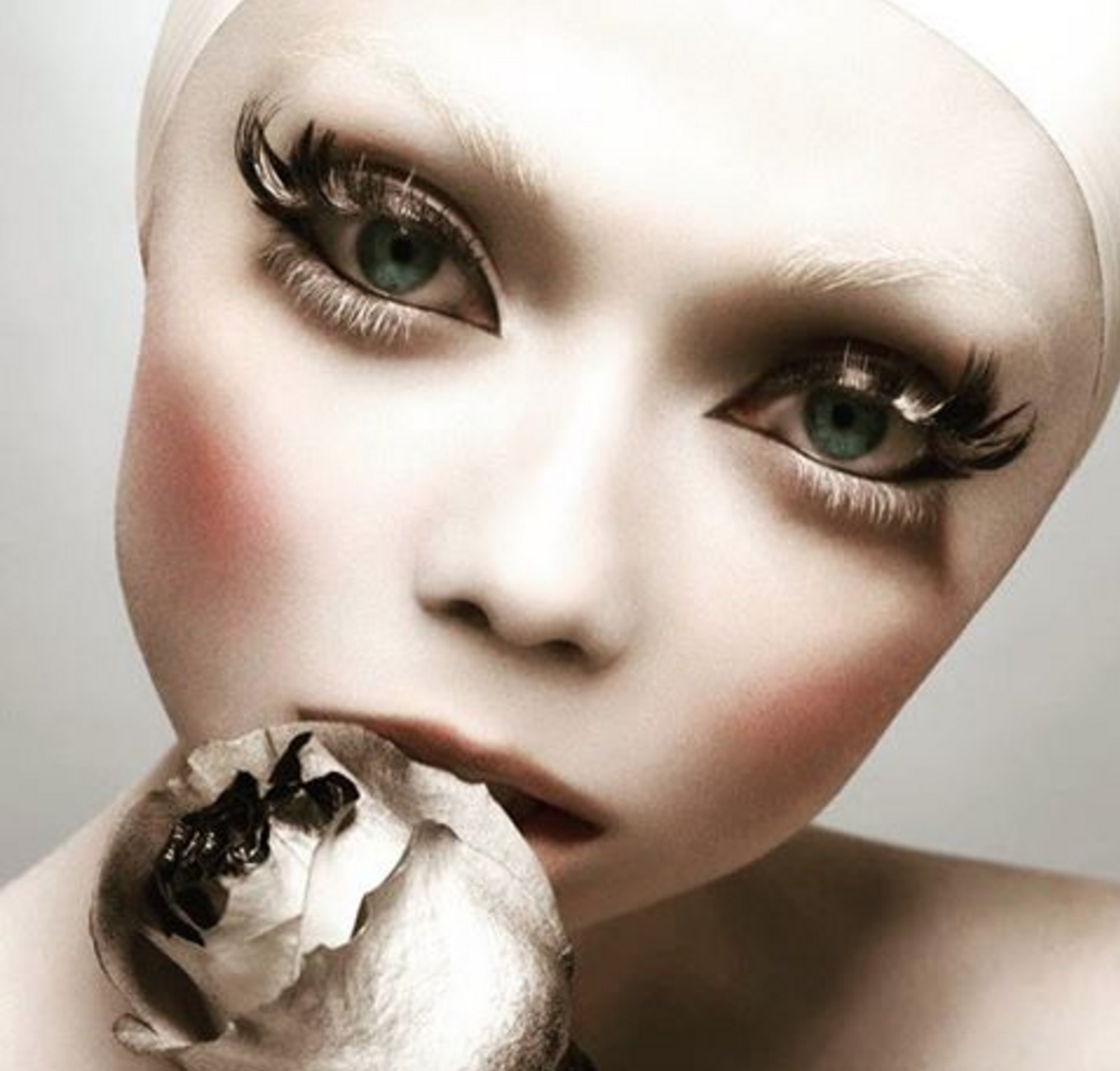
For the next face chart I decided to find inspiration that visually matched my thoughts on the character of Elizabeth Brydges. I found this photo, the make-up done by Alex Box, from a 2014 edition of Vogue. Instantly the pale skin, bleached brows and bold heart-shaped lips reminded me of Elizabethan fashions. Also, the large, furry ruff and the jewellery in the model's ears and on her fingers were similar to those in Elizabethan portraiture. However, I liked how, unlike Elizabethan portraiture, the spidery lashes and pinky-purple eyeshadow added a sense of mischief and flirtation; reminding me of the impression I get from the Lady in Waiting, Elizabeth Brydges.
I used this look to help me create my face chart. I kept the colour scheme and eyeshadow placement, but in my own look removed the beauty spots seen beneath the model's eyes, as I am aware that in the Elizabethan era they often tried to remove freckles and other such blemishes. I also kept the eyelash placement, below the lower lash line to make the eyes appear larger and doll-like, maintaining the flirtatious and playful theme. I adapted the lips slightly, using more of an ombre effect. 
I couldn't decide which look I preferred, out of this look and the first one I created. I liked the bold brows in the first one, but the bold colour scheme in the second. I feel I need to practice my application techniques on face charts - I frequently smudged the make-up, ending up with shapes I had not originally wanted; for example I would've preferred more heart-shaped lips, mirroring the heart-shaped hair that was preferable in Elizabethan styles. 

My final look was taken from the work of Frances Hathaway, a make-up artist I had not discovered before. I absolutely loved the white strip across the eyes in this photo by Yulia Gorbachenko. This, the bold lip, and golden tones, reminded me of Elizabethan make-up. Again, the black lip colour, as opposed to the typical Elizabethan rouge, reflected my thoughts of Elizabeth Brydge's darker, unruly tendencies. I felt that this look modernised Elizabethan make-up through the eyes; it is almost as though the typical Elizabethan look is physically emerging through them. I liked that the model, Vanessa Cruz, does not appear to be wearing clothes; or at least they are low-cut. This reinforces the flirtatious themes I would like to follow in my work.
For my third face chart I followed the make-up in Hathaway's look. I felt that this look ended up a bit messy, as I struggled with products and smudging them. I tried to recreate the golden and bronze tones, and heavily highlighted upper lip, nose and inner corner, as I felt that these features in particularly were what made the look more contemporary, as in Elizabethan times the make-up was often very matte. I made the brows a bit bolder, however I think I should have experimented with middle-ground eyebrow, to see how it would have looked with visible, but thin brows; as two of my face charts have bold brows. 

In terms of hair, I will most likely opt for a pushed-back hairline, possibly with milkmaid plaits across the top of the head, furthering the illusion of a large forehead.
Following this exercise, I feel much more inspired and confident about working towards my final outcome. Before this, I did not have much inspiration, or any ideas. Now, however, I know that I enjoy playing around with the playful and disobedient themes, and how I can visually represent them. I seem to gravitate towards golden shades and bold colours; I really liked the use of dark pink and bold lips. I also liked the long, messy eyelashes, and think that this may be something I incorporate in my finished piece. 


Monday, 2 November 2015

Inspiration: Frances Hathaway and London Make-up School

Frances Hathaway

'Hallow'
Makeup: Frances Hathaway
Photographer: Yulia Gorbachenko
Model: Vanessa Cruz
Retoucher: Cristian Girotto


Yulia Gorbachenko shoot


@houseofglamdolls instagram (London Make-up School)

Artist: Sharon Dowsett


Artist: Damian Garozzo


Thursday, 22 October 2015

Peer Assessment

I feel relieved, having shown my work to my peer. What concerns me, however, is the huge workload -  I find it stressful keeping up, and get worried I have missed things or not done them to a high enough standard. For now, though, I feel up to date and on top of the work load. I feel confident in talking about my posts, and enjoyed being able to talk about my blog, especially as I was working with a student who is new to the course, and so further behind with her work and understanding of the course; it was nice to help and reassure her. I learnt more about first year and what the work I am doing goes towards. However, I feel unsure about the fact that my lecturers haven’t looked at my blog as I don’t always trust my own, or my peers’ judgements! To solve this, I will perhaps attend drop-in one-on-one sessions with teachers. What I found difficult to handle in today’s seminar was the assessment sheet checklist, as I struggled to understand the language and terminology! Something I need to improve in my blogs is my use of Harvard referencing. Other than that, my use of photos, reflective work, practice outside and inside of class, and presentation is good, and I am happy with my progress. 


Monday, 19 October 2015

Portraits and Symbolism (+ own self portrait)

Even in modern portraits and photographs, people still have status symbols. However, of  course, they now have a more modern feel compared to Elizabethan symbols. For example, luxuries like pearls have become statement necklaces, elaborate dresses have become branded clothes, crowns or headdresses may have become other accessories like watches.  Despite the development, they still follow a theme; clothes and accessories hark back to older times, yet still now, make the person in the image seem important. Sometimes, this importance is communicated through traditional clothes or objects; for example in the Elizabethan era, in the Queen's coronation portrait, she wears the cloth of gold previously worn by Mary I at her coronation, and she holds the orb and sceptre which show authority; similarly, we still wear or hold traditional items in today's portraits, such as at weddings - a wedding dress, veil, and bouquet. 


This portrait by Yu Tsai shows wealth through the model's clothing. Her shoes, bracelets, the material of the garment and how her hair has been styled all appear luxurious. Also, the location in the background is picturesque. The movement captured and her facial expression demonstrate confidence and power.   


In this photo the sunglasses, necklace, earring and bag strap imply wealth, and when contrasted with the relaxed hairstyle and casual clothing it shows a confidence, suggests an awareness of the wealth, and creates a carefree attitude. Roses are typically symbols of love or beauty, and the positioning of the rose in this picture, on the model's chest, supports this; however the dark shade suggests perhaps a tainted kind of love, or maybe heartbreak. 


The striking red tie and shoes in this image symbolise wealth, power, love, danger, and more. The background and gun further the idea of danger, but the confident stance and facial expression create a more relaxed effect. 


This self portrait holds symbolic references about me. The background shows my friends, and the fact that I have many photos of them shows how important they, and the memories we share, are to me. I wear casual clothes, implying a relaxed personality, and also showing I am not the wealthiest character - contrasting this, the jewellery I hold, the style of my hair and the make-up I am using, shows I still have an eye for luxurious items. I am seen doing my make-up, simply showing my interests and hobbies, and holding a wine glass to represent how I like to have fun and go out! I faded the photo slightly after it was taken, symbolising my love for previous eras such as the 80s. 


Sunday, 18 October 2015

The Ditchley Portrait

The Ditchley Portrait, 1592


  • What symbolic references are within the portrait? 
    • Stood on England on a globe symbolising her power over the country, feet on Oxfordshire as that's where Lee was from. 
    • Gloves: elegance. 
    • Pearls: virginity. 
    • Fan: union, wealth. 
    • Jewelled celestial sphere hanging from her left ear: command over nature itself. 
    • Tudor rose: dynasty, unity of realm, religion. 
    • Weather in background: royal authority over nature. 
    • Writing on right: theme of forgiveness. 
  • What does the clothing say about the sitter? Identify his/her physical characteristics, age, and social class, influences and personality type 
    • Very wealthy. 
    • White satin = purity, peace. 
    • White silk puffing with pearls/rubies/sapphires set at intersections: wealth, beauty, virginity. 
    • Very slim, long, pointed bodice.Headdress is crown shaped: royalty. 
    • Jewels in headdress: wealth. 
    • Portrait done at an older age (59).
    • Stern look, importance
  • When you get back to Uni, research the background of this image. 
    • Weather is blue and sunny sky on the left, and black and stormy sky on the right: continues the theme of royal authority over nature. 
    • 'The three fragmentary Latin inscriptions can be interpreted as: (left) "She gives and does not expect"; (right) "She can but does not take revenge", and (bottom right) "In giving back she increases." The sonnet (right), perhaps composed by Lee, though fragmentary, can mostly be reconstructed. Its subject is the sun, symbol of the monarch.'
  • Who is the sitter, why are they sitting for the portrait? 
    • Queen Elizabeth I, painted for Sir Henry Lee who had been the Queen's Champion from 1559-90


Sunday, 11 October 2015

Key films and actors who played Elizabeth

Fire Over England (1937); Flora Robson
Quite a convincing representation of Elizabeth.
The Private Lives of Elizabeth and Essex (1939), The Virgin Queen (1955); Bette Davis 
Davis' second portrayal was definitely less accurate and effective; the hair looking almost dragqueen-like. 
Elizabeth R (1971); Glenda Jackson
Jackson's portrayal first showed Queen Elizabeth's more natural, healthy looking youth, and then the transformation into being heavily made-up, with attention to details like damaged skin. However this film took quite a 70's approach, for example the high, streaked blusher, lessening the accuracy from the original era.
Blackadder (1980s); Miranda Richardson
Comedy series Blackadder's recreation of Queen Elizabeth was much less accurate, with a more tanned face, lower hairline and stronger eyebrows, but there was never any intention to be otherwise.
Elizabeth (1998); Cate Blanchett
Like in Elizabeth R, Blanchett's Elizabeth effectively showed the transition from youth to maturity and the simultaneous changes in appearance; although with a more accurate end result, less tainted by the conventions of the time the film was created. 
Shakespeare in Love (1998); Judi Dench
Even Judi Dench, who had a very small role in this film, shaved her hairline and plucked her eyebrows for her portrayal, showing just how iconic Elizabeth was and how amazing an opportunity it is considered to be able to perform as her. 
The Virgin Queen (2005); Anne-Marie Duff
This version of the Queen lacks such a strong white base and red lips and cheeks, but the hairline is still raised and the eyebrows still removed.
Elizabeth I (2005); Helen Mirren
Mirren's portrayal is perhaps the least impressiveness in appearance; she possibly even looks more Queen Elizabeth II. 


Overview of the use of Tudor cosmetics

In the Tudor and Elizabethan eras, pale skin denoted wealth and class and so the use of cosmetics to enhance this effect was common. On the skin, white lead or ceruse (white lead and vinegar) was used, however this was extremely damaging for the complexion and harmfully toxic for the skin, meaning more was then worn to cover up the damage! On top of this, a glaze of egg whites was added to preserve the cosmetics underneath. Queen Elizabeth even began to paint on fine blue veins to amplify the translucency. To add a hint of warmth and life to the face the cheeks were blushed with red ochre or more white lead mixed with a red dye. Making the skin look even more pale, the lips were often coloured a bright red by using a pencil made from alabaster or plaster of Paris mixed with a colourant, preferably red ochre, but for wealthier women, vermillion.
Solutions for damaged skin, or for blemishes and freckles, included the application of lemon juice, or even mercury; this acted as a facial ‘peel.’  
In this era, bathing and taking care of hygiene was not popular. Hair was washed sometimes as little as four times a year, with the use of lye; a mixture of wood ash and water. Queen Elizabeth is said to have bathed once a month. This lack of washing increased the requirement for perfumes, although ingredients were not as resistant as they are today and so repeated applications must have been necessary. Rose water was popular, but Elizabeth’s supposed own personal scent was made from marjoram and herbs; neither ingredient having particularly good longevity.  Others of her somewhat strange recipes include puppy fat and apples to make a hair pomade; posset curd to make an anti-wrinkle treatment for her forehead; and egg-whites, powdered egg shells, alum, borax and white poppy seeds to make a skin lotion. Hair bleaches sometimes contained urine, and dyes were often made from a mixture of saffron, cumin seeds, celandine and oil.

Recipes for male hair dye:
  • Elizabethan: lead, sulphur, lime, water; leave on hair for at least 15 minutes, rinse, rinse again with soap.
  • Modern: black walnut powder + water, leave to stand for six hours; rinse over head, dry in the sun, repeat daily.

Recipes for lightening skin:
  • Elizabethan recipes for skin-whitening:
    • Recipe 1. wash the face in rosemary boiled in white wine.
    • Recipe 2. White tartar, camphire, copperas (iron sulphate), egg whites, lemon juice, tartar oil, plantain water, white mercury, almonds; powder all dry ingredients, mix with liquids, boiled, strained; rub face with scarlet cloth, wash with mixture, rinse off with bran and white wine.
  • Modern skin-whitening recipe: plain yoghurt, honey, lemon juice, almonds, turmeric, oatmeal.

Recipes for removing freckles:
  • Elizabethan recipe: sap from a Birch tree
  • Modern recipe: sour cream, honey, onions, papaya, and buttermilk. 


Recipes for mouthwash:
  • Elizabethan recipe: Vinegar, water from a masticke tree, rosemary, mirrhe, masticke, bole (stem/trunk of a tree), Arkmoniake, Dragon’s herbe, roche allom, fountain water, honey; mix and boil all. 
  • Modern recipe: water, baking soda, peppermint oil, tea tree oil

I found it very interesting how much cosmetics and their ingredients have evolved, and am impressed at the Elizabethan's experiments. It is interesting how ingredients like lemon juice and cochineal are still used today. Above all, I was surprised to discover how infrequently Elizabethans washed despite their obsession with appearance!